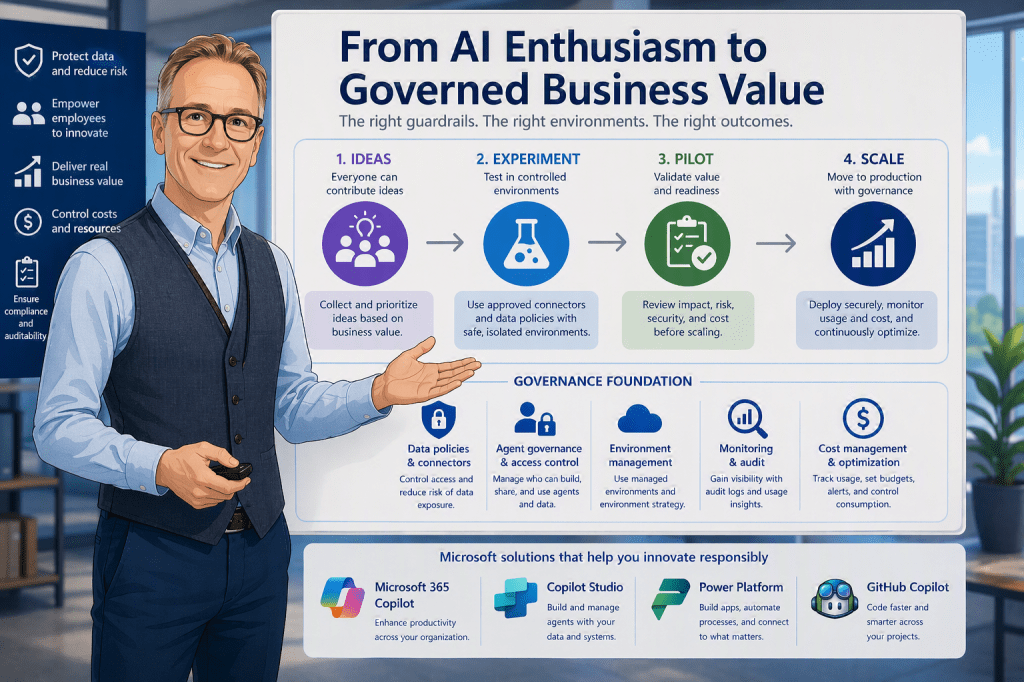
AI adoption is no longer limited to specialists. Many organizations now have employees who want to use AI to improve daily work, automate processes, build agents, connect systems, and experiment with new ways of working.
That enthusiasm is valuable. But without governance, broad AI experimentation can quickly create challenges around data protection, cost control, ownership, environment management, and lifecycle management.
Microsoft’s Power Platform governance guidance describes governance as the policies, practices, and tools used to manage and control platform usage so it can be used efficiently, securely, and in compliance with organizational standards. Microsoft also recommends assigning administrative responsibility, establishing an environment strategy, supporting governance at scale, and managing environments throughout their lifecycle. [learn.microsoft.com]
The goal should therefore not be to stop innovation. The goal should be to make experimentation safe, measurable, and connected to real business value.
The Problem Is Not Experimentation. The Problem Is Uncontrolled Experimentation.
There is a major difference between testing AI in a limited way and building solutions that connect to organizational data, external services, APIs, or automated actions.
Microsoft explains that Copilot Studio agents can connect to many data sources and services, including external non-Microsoft services, and that organizational data is one of the most important assets administrators are responsible for protecting. Microsoft also explains that data policies let administrators govern how agents connect to and interact with data and services inside and outside the organization. [learn.microsoft.com]
Power Platform data policies are described by Microsoft as guardrails that help reduce the risk of users unintentionally exposing organizational data. These policies allow administrators to control access to connectors in different ways to help reduce organizational risk. [learn.microsoft.com]
This means that once an AI experiment involves business data, connectors, external services, or automated actions, it should no longer be treated as an informal personal test. It should be treated as an early-stage business solution that needs governance.
Everyone Should Be Able to Submit Ideas
A healthy AI adoption model should allow employees across the organization to propose ideas. Good ideas often come from people close to the work, the process, the customer, or the operational problem.
However, ideas should be structured before they receive access to sensitive data, production systems, connectors, agents, or consumption-based services.
Microsoft’s Innovation Backlog guidance for Power Platform describes a structured way to gather ideas, document pain points, describe involved personas and tools, capture improvement measures, and calculate ROI and complexity so that the most impactful ideas can be prioritized. [learn.microsoft.com], [learn.microsoft.com]
A practical AI idea should therefore answer:
- What problem are we trying to solve?
- Who has this problem?
- What value could this create?
- What data is needed?
- Which systems or connectors are involved?
- Is external connectivity required?
- What risks exist?
- How will success be measured?
Submitting an idea should be easy. But submitting an idea should not automatically grant access to production data, external connectors, custom integrations, or unlimited AI consumption.
Controlled Environments Make Experimentation Safer
If an organization wants employees to experiment responsibly, it needs controlled environments where promising ideas can be tested without immediately creating production risk.
Microsoft describes Managed Environments in Power Platform as capabilities that allow administrators to manage Power Platform at scale with more control, less effort, and better insights. Managed Environments include capabilities such as environment groups, sharing limits, usage insights, data policies, maker welcome content, solution checker, and other governance features. [learn.microsoft.com]
Microsoft’s managed governance guidance also describes environment groups, governed settings, delegated administration, and environment routing as ways to manage environments at scale and direct makers to safer personal developer environments. [learn.microsoft.com]
A controlled AI experimentation environment should therefore include:
- separation from production
- clear ownership
- limited lifetime
- restricted access to data
- approved connectors
- usage monitoring
- auditability
- clear publishing rules
This makes it possible to encourage experimentation without allowing every experiment to become a production-level risk.
Connectors Need Clear Governance
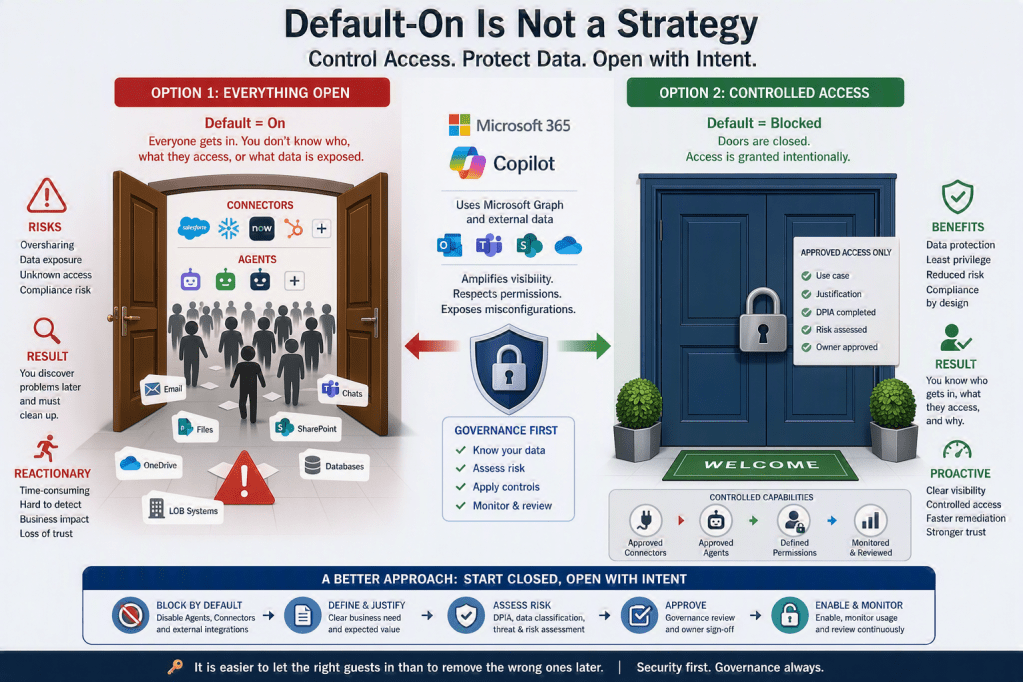
Connectors are often what make low-code, automation, and agent solutions useful. They are also one of the main areas where governance is needed.
Microsoft explains that connectors are a core part of Power Apps, Power Automate, and Microsoft Copilot Studio, and that data policies allow administrators to control access to connectors to help reduce risk. Microsoft also explains that custom connectors require careful consideration so they comply with data policies and do not compromise data security. [learn.microsoft.com]
Microsoft’s connector classification documentation describes three data groups in data policies: Business, Non-Business, and Blocked. Connectors can be categorized based on whether they connect to business-use services, personal-use services, or should not be used in selected environments. [learn.microsoft.com]
For Copilot Studio agents, Microsoft explains that connectors can also be classified in data policies as Business, Non-business, or Blocked, and that Copilot Studio supports real-time data policy enforcement where makers and users see errors for policy violations. [learn.microsoft.com]
A practical governance model should define:
- which connectors are allowed for general experimentation
- which connectors require review
- which connectors are blocked
- when custom connectors are allowed
- when external services may be used
- when production data may be used
- who can approve exceptions
For organizations working with newer connector governance capabilities, Microsoft also describes advanced connector policies, including a default-deny posture where connectors and actions are blocked unless explicitly allowed. The same article also notes MCP server-level blocking support for MCP connectors. [learn.microsoft.com]
Agents Should Be Managed as Organizational Solutions
Agents can start as small experiments, but they can quickly become part of the organization’s digital workplace.
Microsoft explains that agents for Microsoft 365 Copilot can be managed in the Microsoft 365 admin center. Administrators can manage access to Copilot and Copilot agents for the whole organization or specific users and groups, review and approve agents submitted to the organizational catalog, and monitor agents shared across the organization. [learn.microsoft.com]
Microsoft also explains that administrators can enable, disable, assign, block, or remove agents, and that members of the organization can only access agents that the organization has allowed. [learn.microsoft.com]
Microsoft’s Agent Registry documentation describes a centralized view of agents available to the organization, including Microsoft agents, external partner-built agents, agents published by the organization, and agents shared by individual creators. It also includes visibility into agents without owners and unmanaged agents. [learn.microsoft.com]
The governance principle is simple:
An agent that uses organizational data, performs actions, or is shared with multiple users should not be treated as a private experiment. It should be managed as an organizational solution.
Such agents should have:
- a clear owner
- defined purpose
- approved data sources
- access controls
- documented sharing model
- administrative visibility
- lifecycle management
Cost Must Be Managed Before Usage Scales
AI costs can grow as more agents, users, actions, connectors, and features are added.
Microsoft explains that Copilot Studio uses Copilot Credits as the unit that measures agent usage. Microsoft also states that the number of Copilot Credits consumed depends on the design of the agent, how often customers interact with it, and the features used. [learn.microsoft.com]
Microsoft’s Copilot Studio licensing documentation explains that Copilot Credits are the common currency across Copilot Studio capabilities and that they can be obtained through pay-as-you-go meters, prepurchase plans, and prepaid pack subscriptions. [learn.microsoft.com]
Microsoft also explains that administrators can manage Copilot Studio credit capacity in the Power Platform admin center and monitor capacity consumption. The documentation describes daily consumption data at environment level and historical monthly usage data that supports budgeting and licensing planning. [learn.microsoft.com]
Every AI experiment that uses paid or consumption-based capabilities should therefore have:
- an owner
- a purpose
- an expected usage pattern
- an estimated cost
- a budget limit
- a review date
- a decision point
- a plan for closing or scaling
The point is not to make experimentation difficult. The point is to avoid experiments becoming permanent cost drivers without business value.
Usage and Activity Should Be Monitored
Governance should not stop once an experiment has been approved.
Microsoft explains that Copilot Studio provides audit logs in Microsoft Purview for administrative, maker, and user interactions with agents. Microsoft also explains that changes to agent content and settings can affect security and behavior, and that auditing helps with compliance requirements and security monitoring. [learn.microsoft.com]
Microsoft’s Copilot Studio security and governance documentation also describes controls such as data policy controls, maker audit logs in Microsoft Purview, audit logs in Microsoft Sentinel, sensitivity labels for SharePoint knowledge sources, maker security warnings, automatic security scans, environment routing, and maker welcome messages. [learn.microsoft.com]
This means organizations should regularly review:
- which agents exist
- who owns them
- which environments they use
- which connectors they depend on
- whether they are still active
- whether they still have a business purpose
- whether usage and cost are reasonable
Unused, ownerless, or unmanaged solutions should not be allowed to remain indefinitely.
Lightweight Review Is Better Than Heavy Bureaucracy
Organizations need a way to prioritize AI initiatives, but the review process should not become so slow that people avoid it.
Microsoft’s Power Platform governance guidance recommends governance practices that support efficient and secure management at scale, as well as a strategy for creating, managing, and decommissioning environments. [learn.microsoft.com]
Microsoft’s “manage adoption at scale” guidance describes the need for a governance framework with clear policies, roles, responsibilities, data access controls, solution development standards, environment management procedures, and monitoring tools. [learn.microsoft.com]
A lightweight AI review forum should assess:
- business value
- data needs
- connector requirements
- security risk
- expected cost
- ownership
- readiness for pilot or production
The purpose should not be to block ideas. The purpose should be to help good ideas move forward safely and stop unclear, risky, or low-value experiments before they consume too much time, data access, or budget.
Normalize Closing Experiments
Every experiment should have an end date.
If experiments do not have a defined review point, organizations risk accumulating half-finished solutions, unclear ownership, unnecessary capacity consumption, and unmanaged data access.
Microsoft’s governance guidance explicitly includes creating, managing, and decommissioning environments as part of an environment strategy. [learn.microsoft.com]
After 30 or 60 days, every AI experiment should lead to one of three decisions:
Continue
The idea has potential, but needs more time.
Scale
The idea has proven value and should move toward pilot or production.
Close
The idea did not show enough value, was too risky, was too costly, or solved a problem that was not important enough.
Closing an experiment should not be treated as failure. It is part of responsible governance.
The Key Principle: Do Not Limit People. Limit Risk, Cost, and Production Access.
The message should be:
Everyone is encouraged to contribute ideas and learn how AI can improve work. Everyone can experiment within safe boundaries. But initiatives that involve sensitive data, external systems, connectors, agents, automated actions, or consumption budgets require clear value, ownership, governance, and risk approval.
That approach aligns with Microsoft’s guidance around Power Platform governance, Copilot Studio data policies, agent management, auditability, environment management, and cost monitoring. [learn.microsoft.com], [learn.microsoft.com], [learn.microsoft.com], [learn.microsoft.com]
Conclusion
AI experimentation is necessary. Unlimited AI experimentation is not sustainable.
Organizations should create a model where:
- all employees can submit AI ideas
- promising ideas are evaluated in a structured way
- safe experimentation happens in controlled environments
- connectors and external integrations are governed
- agents are managed as organizational solutions
- costs are monitored through capacity and usage reporting
- audit and compliance controls are used
- experiments have owners, purpose, and end dates
- only solutions with clear value move toward production
That is how organizations avoid creating an expensive AI playground.
Not by killing curiosity.
Not by limiting innovation to a small group.
But by connecting innovation to responsibility, security, cost control, and measurable business value.
Disclaimer
This blog article was partly written, reviewed, and refined with the assistance of Microsoft 365 Copilot. The content has been edited and validated by the author, and the factual references are based on official Microsoft documentation.






Leave a Reply