
Being Copilot Ready is one thing; becoming Agent Ready is a whole different challenge.
AI agents, Copilot solutions, and low-code development are advancing faster than ever. Organizations across industries are eager to empower employees to build their own solutions using Microsoft Power Platform, driving efficiency, automation, and innovation closer to the business. However, there is a challenge that many organizations underestimate.
Before scaling the use of AI agents and citizen development, companies need to ensure that the necessary governance, security, and compliance controls are already in place. Otherwise, they risk creating a rapidly growing ecosystem of apps, automation flows, and AI agents that nobody truly has visibility into or ownership of.
The Hidden Risk in Many Power Platform Environments
All organizations have a Default Environment in Power Platform. This environment often becomes the natural starting point for users creating:
- Copilot agents
- Power Apps applications
- Power Automate flows
- Dataverse solutions
- Integrations and connections to external services
The challenge is that the Default Environment was often established long before the organization took a strategic approach to Power Platform governance and security.
As a result, business-critical solutions may be developed and operated in environments that lack the same level of control, monitoring, and lifecycle management as professionally managed development, test, and production environments.
In many cases, organizations do not have full visibility into:
- Which solutions are actively being used
- What data is being processed
- Which external services are connected
- Who owns individual solutions
- Whether solutions comply with internal and regulatory requirements
- Whether data is being stored or processed outside approved geographic boundaries
This is not primarily a technology problem. It is a governance problem.
Copilot Agents Make the Issue Even More Important
As organizations begin deploying Copilot agents, the risk profile changes significantly.
A traditional application may support a single business process. An agent, on the other hand, can:
- Access information from multiple sources
- Aggregate and analyze company data
- Perform actions on behalf of users
- Interact with external systems
- Automate processes that were previously manual
If these solutions are developed in poorly governed environments, the potential impact can be far greater than that of a standalone application or automation flow.
Today, many organizations are focused on how quickly they can start building Agents but far fewer are asking whether their platform is actually ready for them.
A Common Misconception
It is easy to assume that introducing personal development environments or other technical safeguards solves the problem. In reality, it rarely does.
While organizations may provide dedicated environments for experimentation, learning, and personal development, users can often still create or move solutions into the Default Environment. This behavior is typically part of the platform’s design and cannot be completely eliminated through technical controls alone.
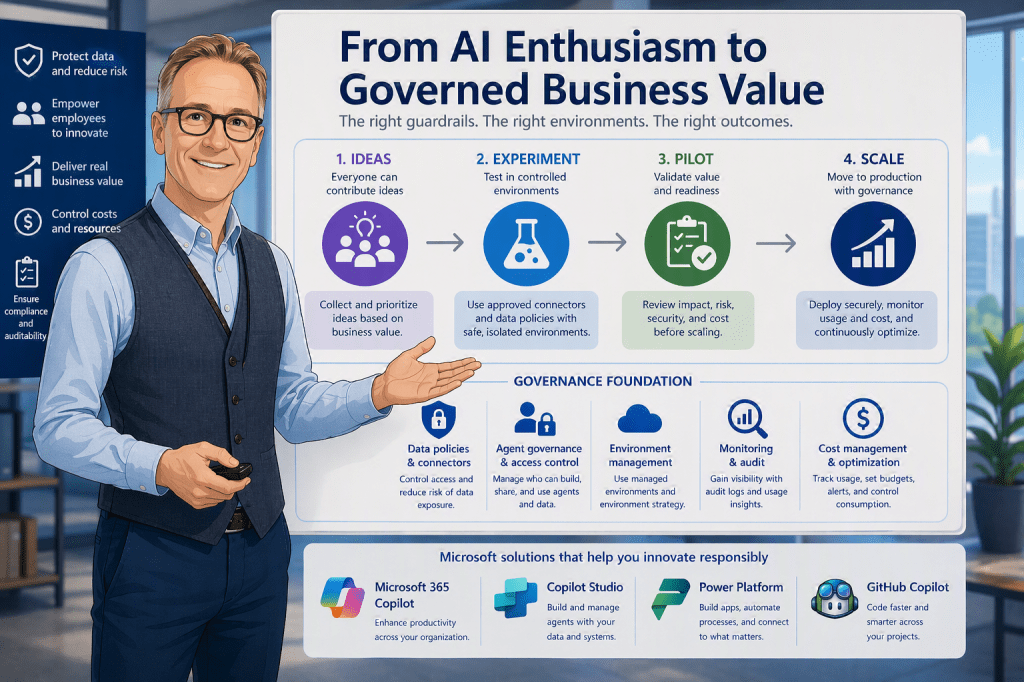
That is why governance must be established across multiple layers:
- Technical controls
- Security configurations
- Policies and standards
- Operational processes
- User education and awareness
No single feature can solve the problem by itself.
Three Areas That Should Be Prioritized
For organizations that want to adopt Agents in a secure and scalable way, three areas deserve immediate attention.
1. Perform a Comprehensive Review of Platform-Wide Settings
Many organizations have never conducted a structured review of their Power Platform tenant settings. As a result, capabilities may be (has surely been) enabled without decision-makers fully understanding the implications.
A governance review should include:
- Security settings
- Sharing capabilities
- AI-related features
- Data governance controls
- Environment management settings
- Compliance configurations
These settings form the foundation of the platform’s overall security and governance posture.
2. Secure and Govern the Default Environment
The Default Environment is often where the largest number of unmanaged solutions reside. Organizations should therefore:
- Inventory apps, flows, and agents
- Identify solution owners
- Review external connections
- Assess data sources
- Evaluate compliance risks
- Establish ongoing monitoring and governance
Special attention should be given to features and configurations that may result in data processing or storage outside approved regulatory, geographical, or organizational boundaries.
3. Establish Clear Development Guidelines
Technology alone is not enough. Employees need clear guidance on:
- When the Default Environment may be used
- When dedicated development environments are required
- When test and production environments should be used
- Which solutions require formal review and approval
- How AI agents should be managed throughout their lifecycle
Clear policies help reduce the risk of users unintentionally building solutions in the wrong place or exposing data to unnecessary risk.
Governance Is Not the Enemy of Innovation
When governance is discussed, some people worry that it will slow down innovation. In practice, the opposite is often true.
Organizations that establish clear guardrails, controlled environments, and common security standards are typically able to scale Power Platform and AI adoption much faster than organizations operating without structure.
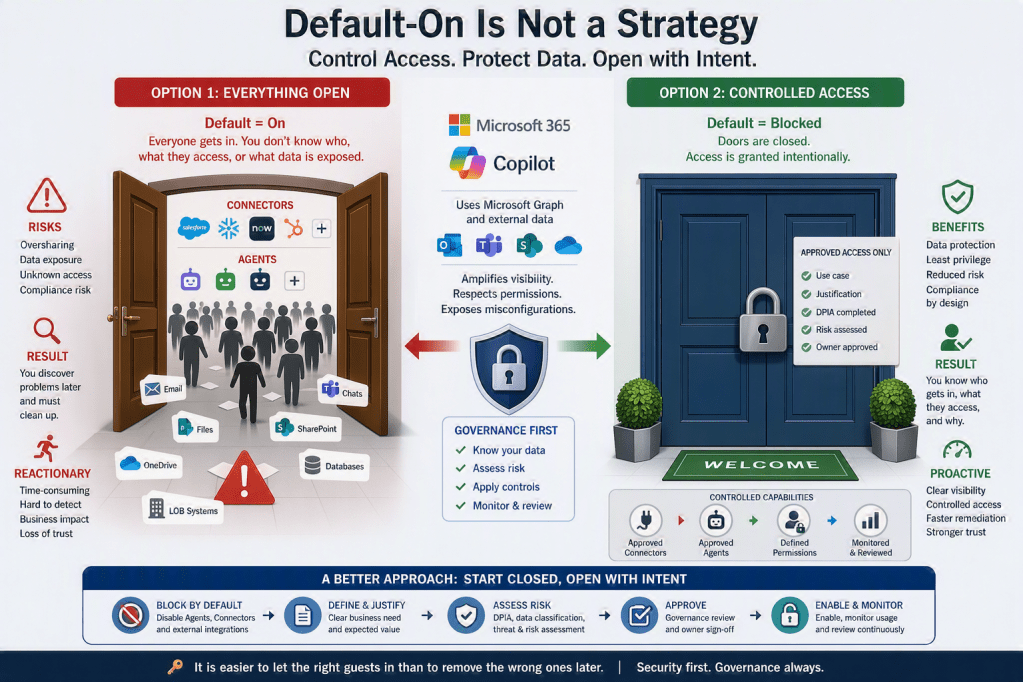
Governance is not about saying no. It is about creating the conditions that make it possible to say yes safely, sustainably, and at scale.
Final Thoughts
The greatest risk associated with Agents in Power Platform is rarely the technology itself. The real risk is that organizations lack sufficient control over the platform where those agents are built, stored, and operated.
Many companies already have hundreds or even thousands of apps, flows, and solutions that have evolved organically over time without a coherent governance strategy. That is why the next question should not be:
“How quickly can we start building AI agents?”
The more important question is:
“Do we have sufficient control over our Power Platform environment to do so safely?”
Organizations that address this challenge today will be far better positioned as Agents evolve from experimentation into business-critical capabilities.
AI Disclaimer
Translated from Swedish to English and refined for clarity using Microsoft Copilot.





Leave a Reply