
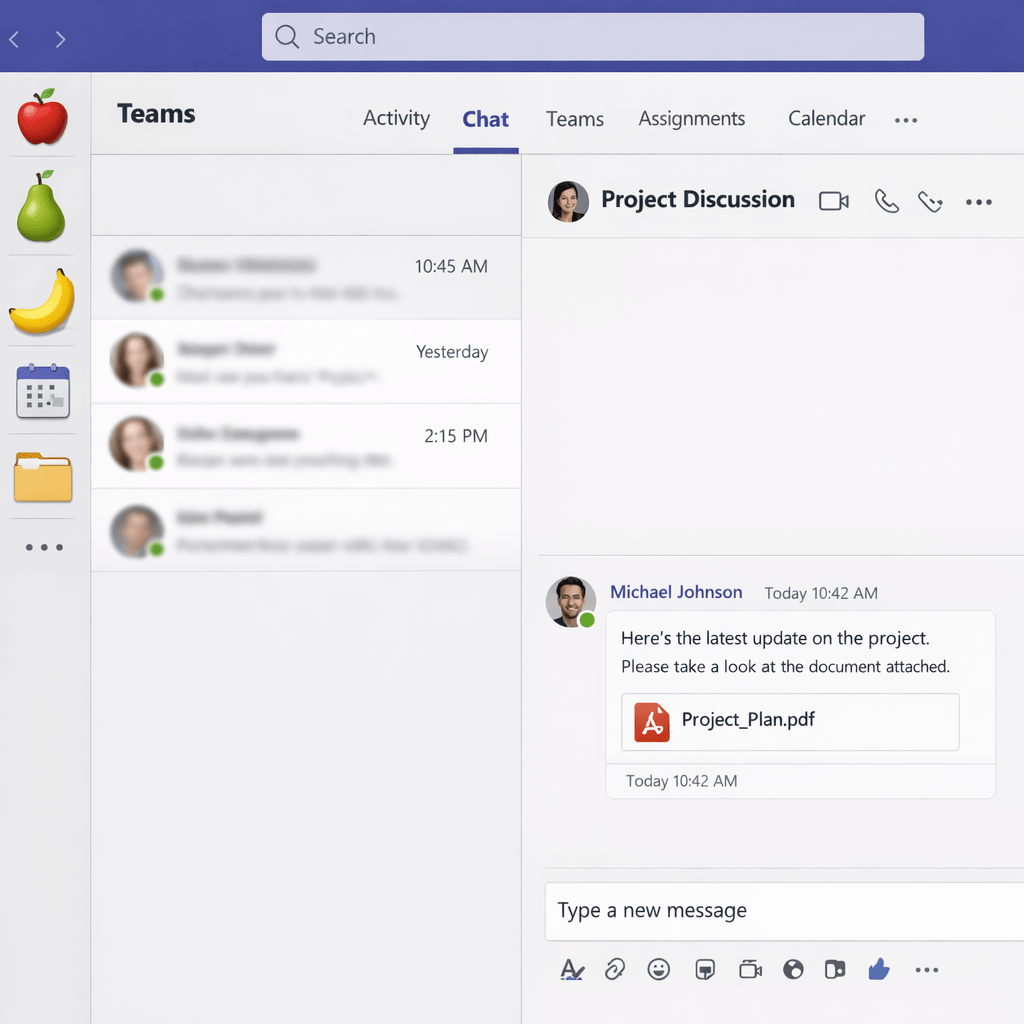
“The new Microsoft Teams chat and channels experience.” This does sound very exciting. So what is going to happen? Well, in short, you can say that Microsoft Teams is soon bringing chats, teams, and channels into one place under “Chat”. The idea behind this change is probably well-intentioned and, with this functionality, users are offered the possibility and freedom to configure their team settings to suit their own individual way of working. However, working in your own way is rarely a winning recipe when one’s work largely consists of collaborating with others. In my head this becomes a bit like using “internal shadow-it”.
Since I sincerely believe that Sharing is Caring (Okay, I’m well aware that this is a cliché and a worn out expression but it still works) and because I also like uniform ways of working, good Information structure and Compliance, I would like to start this post by once again sharing my views on Private Chats (1-1) and Private Group Chats (1-M)
Private Chats (1-1) and Private Group Chats (1-M)
My personal opinion (as most of my followers probably already know 😉) is that Private Chat and Private Chat Groups are one thing, and using team channels properly is quite another.
If you are going to use Private Chat, it should only be when you need to send a simple message to a person. Private group chats can be used for the same purpose when there are only a few people to whom the message is relevant.

Examples of appropriate use of Private Chat
- I’m going to be a little late for our meeting at 11. Could you please start the first ten minutes and I’ll take over afterwards?
- Hey Boss! Do you have the report from my last personal development interview?
Examples of appropriate use of Private Group Chat
- Hello colleagues! Stine’s birthday is on Friday. Should the ten of us get together for a present and a bouquet of flowers for her?
- Hi guys! Svein is getting married in a month. Shall the four of us organize a bachelor party for him?
Why then am I so negative about using Private Group Chats?
I cannot emphasize enough times how important it is that both file sharing, meetings, collaboration and communication take place in the context in which it belongs. That’s why the correct use of Channels in Teams is so incredibly important both considering that it should be intuitive where to create and where to find dialogue, meetings, tasks, presentations, recordings and files related to the subject or the project/department/process .
It is also important considering that the communication and files that are created are also properly stored and protected and that the information is not lost (which is the case if you instead use a Private chat group where all communication and files are in someone’s OneDrive and this the person terminates his employment and his account is deleted.)
Not least, it is easier to configure relevant notifications about what happens in channels, which is not the case in a Private chat where different topics are often mixed and you definitely do not want to receive notifications about irrelevant comments about a topic that is not relevant to you.
Chat is Chat and Collaboration is Collaboration
What is best for teamwork (e.g. a Project Team), “Skype” or a well-structured Team? I get severe allergies and itchy rashes when Private Group Chats are used instead of Channel Posts in the team the posts belong to. Private group chats are not Collaboration. Private chat groups (in vain, ignorant or sloppy attempts to collaborate) are instead the exclusion of other people to whom the information may be relevant. In addition, chat posts in Private group chats create noise and disturbances in the working day where you need to focus on what is relevant and want to shield yourself from things that are not relevant.
Private group chat entails exclusion, unnecessary alerts, poor structure, poor securing and storage of information, poor compliance and difficult-to-manage Governance.
Now I’m done writing negatively about group chats for this time. Just to be clear (because you need to be quite often so that you are not misunderstood) about that matter, it is not the case that just because I think that Private chats in general and Private group chats in particular are negative phenomena means not that I dislike new functionality in Microsoft Teams, on the contrary I embrace it with great interest. My personality is just a complicated combination of early adopter and healthy skeptic. 🤔 The result of that is usually that I am good at differentiating between new functionality that is fun and new functionality that is useful, and what is fun for the individual is not always the same as what is useful for the group.

Now let’s get into the message that this post is really about 😊
When will this new change come and what will happen?
Companies and organizations with access to Teams public preview will be able to try out the new interface starting in November 2024. You will be taken through, a self-service, guided onboarding flow that will help you discover the new experience and configure it to your preferences. If you prefer to continue keep chat and channels separate (I definitely will) can easily do so during the onboarding process, or at any time later.
What I like most about the news coming is the new view “@mentions” which quickly and easily gives me an overview of where someone mentioned me by name as this indicates that it is about something important that requires my attention and action. @mentions are important and if you are not good at using @mentions in your posts in Microsoft Teams, you cannot expect people to react or act on the posts either. Hence i welcome the new @mentions-view.
Read the full announcement here: Streamline collaboration with the new chat and channels experience in Microsoft Teams.
Concluding words
I would like to end this blog post by encouraging you to test new functionality and adopt what you find useful both for you and those you work with. Make sure to prioritize adopting functionality that benefits teamwork more than individual work. Together you produce better results than you achieve alone and it is when we use our tools in a unified way that we understand both each other and the information we produce.






 Providing Tips
Leave a reply to Use Microsoft Teams the right way Part 13 – Chat and channels Combined View or Chat and channels Separate View – Providing Tips Cancel reply